Restoration of the San Quintín Mining Area (Cabezarados, Ciudad Real)

An environmental recovery project with the participation of IGeA

San Quintín Mining Restoration

The Applied Geology Institute (IGeA-UCLM) participates, under a technical assistance framework, in the mining restoration of the abandoned San Quintín area, a project funded by the European Next Generation funds ( more information ) and carried out by the public company TRAGSA.

History and environmental issues of the San Quintín mine

San Quintín corresponds to a mining group, exploited from ancient times until 1930 for the extraction of argentiferous galena, which was processed in a smelter in Puertollano to obtain Pb and Ag. In its final stage the exploitation was carried out by the Sociedad Minera y Metalúrgica de Peñarroya-España (SMMPE). Between 1930 and the 1970s there was no activity in the area. In 1973, a flotation plant was put into operation by SMMPE to process mining wastes, specifically to obtain sphalerite concentrates in order to produce zinc. Galena concentrates (which were sent to the Santa Lucía Smelter in Cartagena) and sphalerite concentrates were obtained, both with relatively high Ag contents. The Zn-Ag concentrates were initially sent to a smelter in Cantabria, later to the Asturiana del Zinc smelter in Asturias, and in the final stage to an SMMPE smelter in France. In 1990, before the flotation plant was closed, mineral processing tests were carried out to separate cinnabar from the Almadén mines.

San Quintín Mines

The mining group is divided into two sectors: San Quintín East, where the North and South veins were exploited through the Don Raimundo and María shafts, and San Quintín West, where the A, BC, Principal, Consecuencia and Cruzante veins were exploited. 
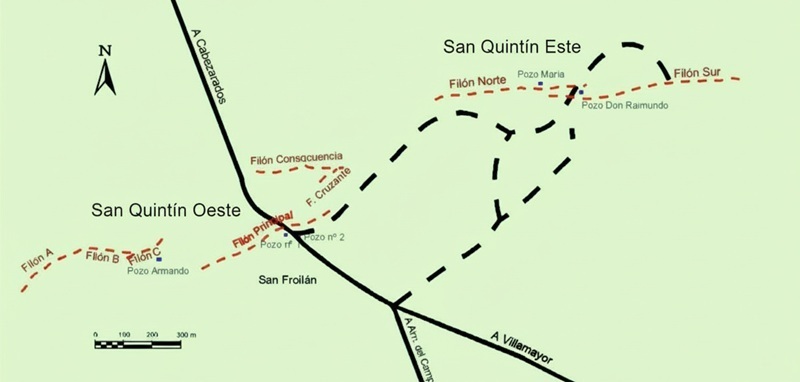
Distribución de los filones explotados en las áreas de San Quintín Oeste y San Quintín Este.
Distribution of the veins exploited in the San Quintín West and San Quintín East areas.
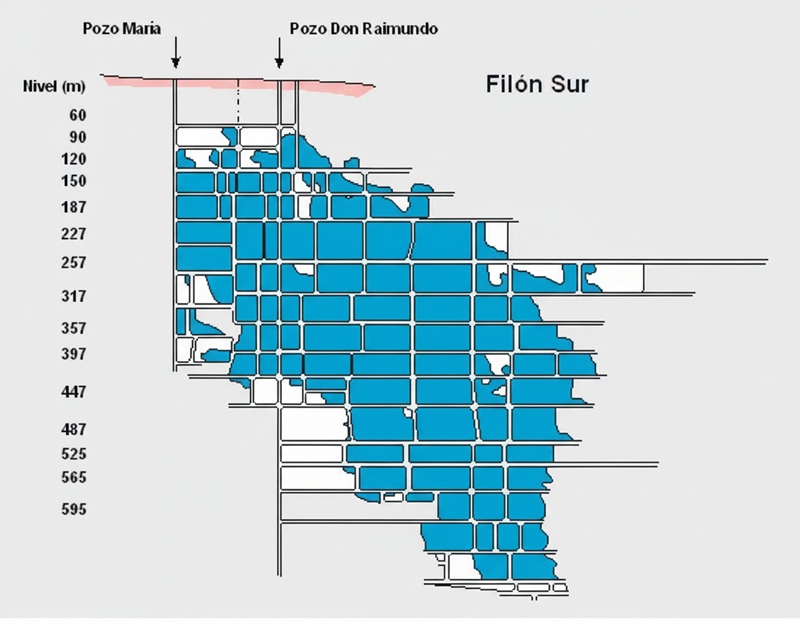
Esquema de las labores sobre el filón Sur, explotado mediante los pozos María y Don Raimundo
Scheme of the workings on the South vein, exploited through the María and Don Raimundo shafts.

Restoration works

The restoration works in the area have been underway since June 2023, and are funded by European Next Generation Funds, and carried out by the company TRAGSA. The Applied Geology Institute, and another team, from the Faculty of Geological Sciences of the Complutense University of Madrid, participate in tasks related to this environmental restoration process.

The main objectives of this restoration are:

  • Reduce the visual impact of the mining waste piles that were left abandoned in the area after the closure of the mine. 
  • Reduce the erosion rates of the soil materials accumulated in the piles. 
  • Reduce the impact of the waste piles on the dispersion by water and wind of the materials accumulated there, reducing their impact on local agriculture and livestock. 
  • Control the formation of Acid Mine Drainage (AMD) that had been occurring in the area, as a consequence of the abundant presence of pyrite, a mineral that promotes this formation. 
  • Reduce mercury emissions to the atmosphere, emissions that are a consequence of the attempt to concentrate cinnabar from Almadén in the flotation plant in 1990. 
  • Maintain as far as possible the archaeological heritage assets present in the area.


For this purpose, the following tasks were established:

  • Remodeling of the waste dumps, covering them with soil and revegetation of it. This affects objectives 1, 3, 4 and 5. 
  • Carrying out a design of the final topography supported by Natural Regrade geomorphological restoration software, which stabilizes the topographic surface (objective 2).  
  • Use soils with high calcium carbonate contents, which limits the production of AMD by neutralization of acidity (objective 4). 
  • Maintenance works of mining industrial buildings, especially focused on the Don Raimundo Shaft.

Reduction of visual impact:

Actions in San Quintín East:

Actuaciones en San Quintín Este
Debris / ruins removal works.
Actuaciones en San Quintín Este
Remodeling of the fine tailings pond (in progress)
Actuaciones en San Quintín Este
Addition of a carbonate-rich soil, as an artificial reactive soil against AMD.

IGeA-UCLM tasks in the process:

Monitoring of the water quality affected by Acid Mine Drainage:

Tareas de IGeA-UCLM en el proceso:  Monitorización de la calidad del agua afectada por Drenaje Ácido de Mina
Sampling by Mercedes Hinojosas Carrasco for her Final Degree Project (November 2001) in the drainage outlet gallery of the San Quintín West waste dump.
Tareas de IGeA-UCLM en el proceso:  Monitorización de la calidad del agua afectada por Drenaje Ácido de Mina
Appearance of the drainage outlet gallery of the San Quintín West waste dump in November 2023, after a long period of scarce rainfall.
Tareas de IGeA-UCLM en el proceso:  Monitorización de la calidad del agua afectada por Drenaje Ácido de Mina
Sampling of AMD coming from the drainage gallery, about 500 m downstream from the gallery (April 2010).
Tareas de IGeA-UCLM en el proceso:  Monitorización de la calidad del agua afectada por Drenaje Ácido de Mina
Measuring physicochemical properties of a puddle where AMD has formed.
Tareas de IGeA-UCLM en el proceso:  Monitorización de la calidad del agua afectada por Drenaje Ácido de Mina
Measuring physicochemical properties of a large puddle not affected by AMD.